Arguments by AudioThing

- Free trial
- No iLok
- Offline support
- No player
- Resizable UI
- Perpetual license
Declared by the developer. Not verified by BetterPlugins.
Arguments by AudioThing
Test Equipment–Inspired Audio Processor
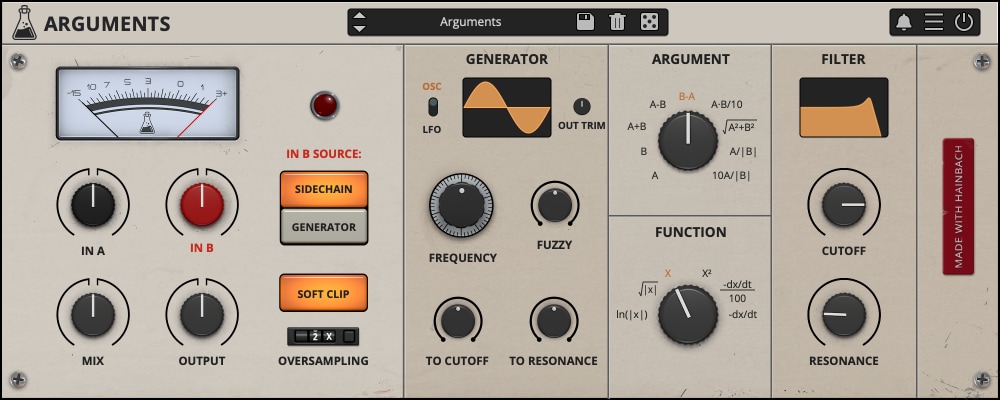
Arguments is a highly unconventional audio processor rooted in the world of vintage scientific and nuclear research instrumentation. Rather than following traditional audio processing models, it treats sound as data to be combined, transformed, and reshaped through analog-inspired mathematical operations. The result is a processor that feels closer to experimental hardware than a conventional studio effect.
Developed in collaboration with experimental musician Hainbach, Arguments is designed to reward curiosity. Presets act only as starting points, encouraging hands-on exploration and discovery through interaction with gain staging, signal routing, and modulation.
Combining Signals Through Analog Math
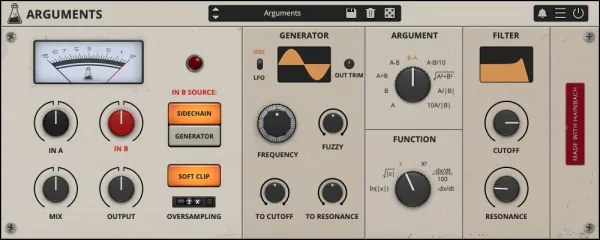
At its core, Arguments takes two signals—A and B—and combines them using a set of mathematical “arguments.” These operations include addition, subtraction, multiplication, division, and other compound relationships derived from analog computing circuits once used in scientific environments.
Signal B can come from an external sidechain or from the built-in signal generator, allowing Arguments to function either as a dual-input processor or as a self-contained tone generator. This flexibility makes it equally suitable for processing audio, generating raw electronic tones, or creating hybrid results that blur the line between effect and instrument.
Function Shaping and Nonlinear Behavior
After the signals are combined, they are passed through a function stage that further reshapes the result. These functions range from logarithmic and square-root responses to derivatives that react to changes over time. Rather than behaving like clean digital math, these stages are modeled to reflect the nonlinearities of analog circuitry.
The most interesting results often emerge when the system is pushed to its limits. As levels approach instability, the processing can collapse, crackle, or erupt into complex textures, echoing the behavior of overloaded op-amps in rare laboratory equipment.
Filtering, Modulation, and Oversampling
A multimode filter stage provides focused control over the spectral output, allowing aggressive tones to be sculpted or resonant peaks to be emphasized. This filter can also be modulated, making rhythmic and tonal interactions even more pronounced.
Oversampling plays a creative role rather than a purely technical one. Lower oversampling settings introduce high-frequency artifacts and fizz, while higher settings smooth out the sound. This makes oversampling a deliberate tone-shaping parameter, especially useful for industrial, noise, and experimental applications.
Generator Mode and Experimental Techniques
In generator mode, Arguments becomes a standalone sound source. Sine waves, LFOs, and other generated signals can be combined and processed internally, enabling everything from rhythmic modulation tools to dense clusters of interacting tones. Multiple instances can be stacked to create evolving, organ-like textures inspired by early electronic music studios.
Because each section of Arguments can operate independently, it can function as a distortion unit, a filter, a tone generator, or a complex modulation processor. Its open-ended design encourages unconventional workflows and happy accidents.
A Processor for Exploration
Arguments is not designed for subtle corrective mixing. It is a creative instrument disguised as an effect, built for sound designers, experimental musicians, and producers who enjoy pushing systems beyond their intended purpose.
By translating obscure analog computing concepts into a playable audio tool, Arguments offers a rare kind of sonic freedom—one where instability, imperfection, and mathematical failure become sources of inspiration rather than problems to avoid.