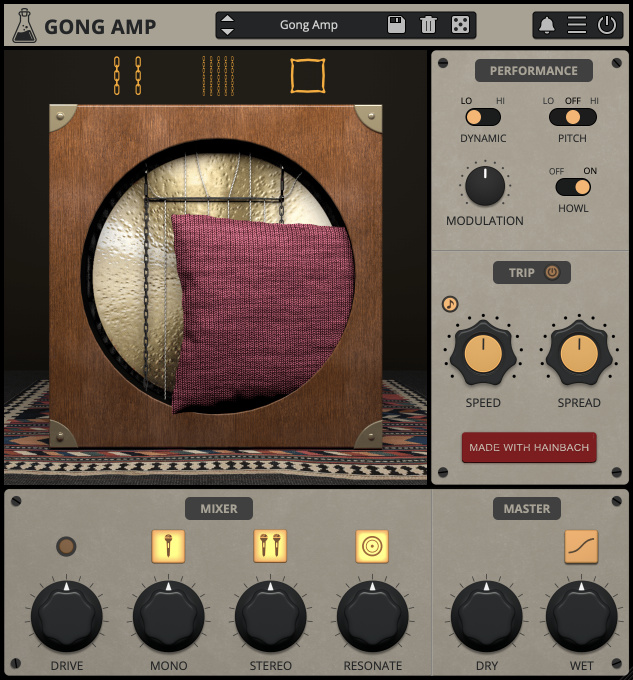
Gong Amp by AudioThing

- Free trial
- No iLok
- Offline support
- No player
- Resizable UI
- Perpetual license
Declared by the developer. Not verified by BetterPlugins.
Gong Amp by AudioThing
The Resonance of Early Electronic Music
Gong Amp is a unique sound-shaping effect that brings the resonant world of early electronic music into a modern plugin format. It is inspired by historic amplifier designs that replaced traditional speaker cones with metal resonators, resulting in complex overtones and long, expressive decays that behave more like acoustic instruments than conventional effects.
Rather than acting as a neutral processor, Gong Amp treats sound as energy interacting with a physical object. Signals excite a modeled gong, producing evolving resonances that respond dynamically to input level, pitch, and modulation. This makes Gong Amp feel less like a static effect and more like a playable, reactive instrument.
Physical Resonance and Character
At the core of Gong Amp is a hybrid system that combines convolution, physical modeling, and feedback networks. This approach captures the distinctive ringing, shimmer, and instability of a metal resonator while allowing far greater control than the original hardware ever offered. Subtle input signals can bloom into harmonic washes, while stronger material can drive the resonator into complex, noisy textures.
The resonance is intentionally imperfect. Small variations in dynamics and pitch produce noticeable changes in tone, giving the sound a living, breathing quality that contrasts strongly with clean digital processing.
Performance-Oriented Controls
Gong Amp includes several controls that shape how the resonator reacts. Dynamic settings adjust how strongly the gong responds to input, while pitch manipulation opens the door to cinematic shifts and unreal tonal movement. Modulation adds motion and width, creating the impression of a physical object swaying or vibrating in space.
A dedicated overload behavior allows the resonator to push back against the signal, introducing howling feedback and unstable harmonics. This makes Gong Amp particularly expressive when used with automation or performance-driven material.
Texture, Rhythm, and Experimentation
Beyond pure resonance, Gong Amp encourages creative experimentation. Additional elements can introduce sympathetic rattling or damping, changing the length and clarity of the resonance. These interactions make it possible to move between long, ringing drones and tighter, more rhythmic responses that work even with faster material.
A dedicated modulation mode enables automated movement between different resonant perspectives, producing slow drifts or fast, rotating effects. This makes Gong Amp especially effective for sound design, transitions, and evolving backgrounds.
A Tool for Cinematic and Experimental Sound Design
Gong Amp excels in contexts where character and texture matter more than transparency. It can add depth and emotion to synths, percussion, vocals, and effects, or become the centerpiece of abstract and cinematic compositions. Its sound naturally evokes early electronic music, experimental percussion, and electro-acoustic traditions.
By reimagining a rare and expressive piece of audio history, Gong Amp offers a distinctive way to shape sound through resonance and physical behavior. It is an instrument for exploration, inviting users to push beyond conventional effects and discover new sonic identities.